Iranian Journal of  Manufacturing Engineering

Iranian Journal of Manufacturing Engineering

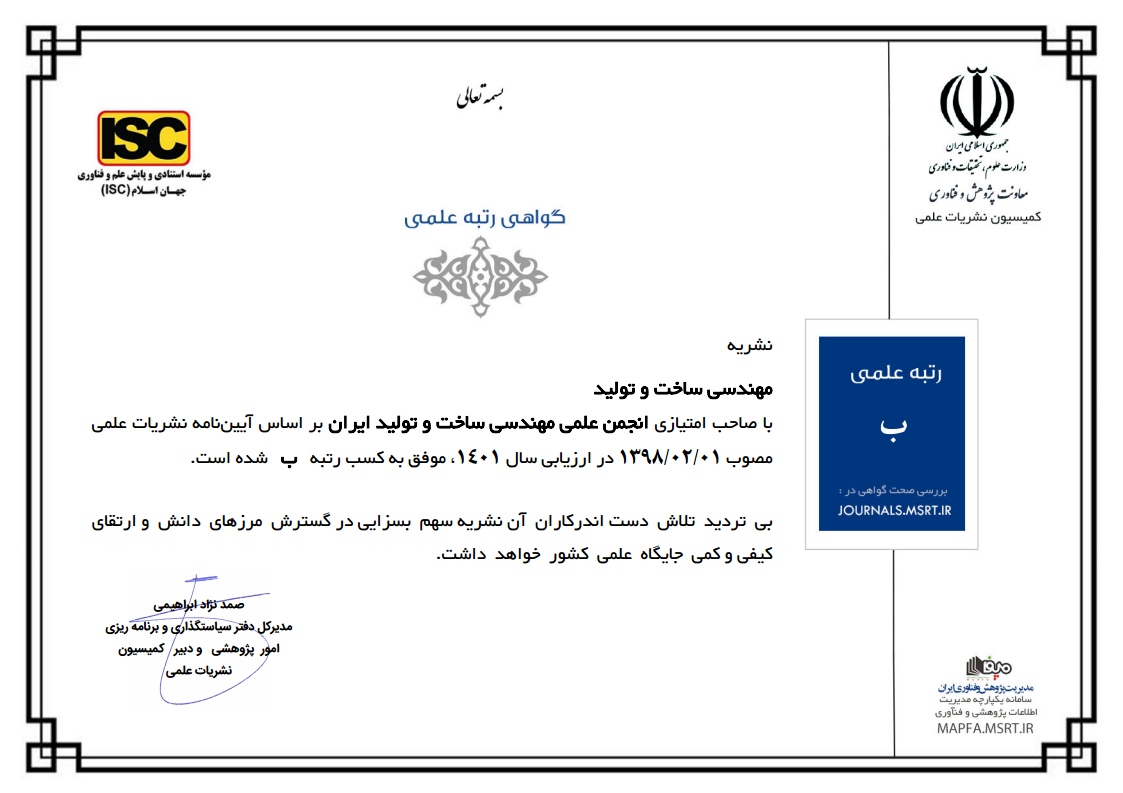
The Journal of Manufacturing Engineering, owned by the Iranian Society of Manufacturing Engineering, has been published since 2012 with the aim of fostering scientific collaboration among universities and national and international specialized scientific associations, and to promote the growth and development of scientific research in the country. Initially issued as a quarterly, it has been published on a monthly basis since September 2019. The Journal accepts and publishes original, previously unpublished scientific-research articles after a rigorous peer-review process and final approval by the Editorial Board, with special emphasis on national-level research and novelty in the field of manufacturing engineering. The average review time is approximately 21 days, and all accepted articles are made publicly available upon final publication. The Journal utilizes the "HamYab" similarity detection system and, accordingly, manuscripts with a similarity index exceeding 20% cannot be considered for publication.


Join the forum's Telegram notification channel (click on the link below)

https://telegram.me/info_smeir


Address:

Tehran, Intersection of Shahid Chamran and Al-Ahmad Highways, Tarbiat Modares University, Faculty of Technology and Engineering, Room 4-18

Telephone and Fax 021-88220216


Current Issue: Volume 12, Issue 12 - Serial Number 98, February 2026, Pages 1-92 

Keywords Cloud

  • Mechanical properties
  • Surface roughness
  • Additive Manufacturing
  • 3D Printing
  • Microstructure
  • Energy absorption
  • optimization
  • Residual Stress
  • Finite element simulation
  • Finite element method
  • Delamination
  • Hardness
  • Nanocomposite
  • tensile strength
  • Drilling
  • Finite Element
  • Material removal rate
  • Severe plastic deformation
  • Simulation
  • Aluminum
  • corrosion
  • response surface method
  • Friction Stir Welding
  • Composite
  • Sandwich Panel
  • fused deposition modeling
  • numerical simulation
  • Turning
  • image processing
  • Taguchi method
  • Wear
  • machining
  • Tool Wear
  • Temperature
  • FEM
  • ultrasonic
  • Genetic Algorithm
  • Ultrasonic Vibration
  • Spring Back
  • Rotational Speed
  • Sensitivity analysis
  • Grain Size
  • Resistance spot welding
  • Cutting force
  • Incremental Forming
  • Compressive strength
  • ABAQUS
  • Friction Stir Process
  • Milling
  • finite element analysis
  • Friction stir spot welding
  • fracture
  • force
  • Grinding
  • Wear resistance
  • Bobbin Tool
  • graphene
  • Fused deposition modeling (FDM)
  • Surface Quality
  • Fused Filament Fabrication
  • Numerical analysis
  • Residual stresses
  • Electrical Discharge Machining
  • Aluminum 7075
  • Composites
  • Digital shearography
  • Composite Material
  • Flexural Strength
  • Piezoelectric
  • Porous Structure
  • Thermography
  • surface integrity
  • copper
  • Ultrasonic Welding
  • Laser Welding
  • Strain Rate
  • Topology optimization
  • vibration
  • Dimensional Accuracy
  • Friction Stir Processing
  • Aluminum foam
  • Taguchi
  • Response Surface Methodology
  • Artificial intelligence
  • Modal Analysis
  • Shunting effect
  • Machining Parameters
  • structural health monitoring
  • Powder Metallurgy
  • Low velocity impact
  • AA6061-T6
  • Finite element method (FEM)
  • Strength
  • Polylactic Acid
  • CK45 steel
  • Surface modification
  • Corrosion Resistance
  • Tensile test
  • Sintering
  • Hot extrusion
  • Finite element model
  • Thickness Distribution
  • Spring-back
  • Silicon carbide
  • microhardness
  • Fiber metal laminate
  • PLA
  • Glass/epoxy composites
  • Brazing
  • Artificial Neural Network
  • Minimum quantity lubrication (MQL)
  • Deep Learning
  • morphology
  • elastomer
  • polymeric foams
  • porosity
  • Structural properties
  • Experimental test
  • Gas turbine
  • Vibration stress relief
  • Supercapacitor
  • 3D-Printing
  • Dielectric Constant
  • nitrile butadiene rubber
  • CFRP
  • Implant
  • Electromechanical Impedance
  • Heat treatment
  • Thermoplastic composites
  • Stability
  • Nanoclay
  • High-entropy alloys
  • Cold roll-forming
  • Hydrodynamic Deep Drawing
  • Non-destructive test
  • Annealing
  • microfluidic
  • Fiber metal laminates
  • Three-point Bending
  • Creep
  • bending strength
  • Planar defects
  • Curved Surfaces
  • Single Point Incremental Forming
  • controller
  • Drilling parameters
  • Second phase
  • Ultrasonic hammer peening
  • Polymer
  • Polyether Ether Ketone
  • Fatigue life
  • Reshaping
  • retained austenite
  • Filler Metal
  • Al6061
  • Cellular Automaton (CA)
  • Bone
  • GTAW welding
  • martensite
  • Specific energy absorption
  • Lubrication
  • Friction drilling
  • Reliability
  • Design of experiments
  • polypropylene
  • Ultrasonic Cleaning
  • Resistance spot weld
  • Formability
  • glass fiber
  • Hole drilling strain gauge method
  • Tool geometry
  • FEM ANALYSIS
  • Metal Matrix Composites
  • FSP
  • Dynamic recrystallization
  • Dimensional Tolerance
  • Pure Copper
  • Thermoplastic Materials
  • micro-alloy
  • Gurson-Tevergaard-Needleman
  • Printing speed
  • Sheet Metal Forming
  • FDM
  • Buckling
  • Aluminum Alloy
  • Basalt fibers
  • Intercritical annealing
  • Aluminum matrix composite
  • ductile fracture
  • fracture strain
  • FEM modeling
  • CHIP
  • aluminum 6061
  • Digital Light Processing
  • 3D print
  • Atomic Force Microscope
  • Carbon Nanotube
  • Hardness test
  • Metamaterials
  • Flower pattern design