Iranian Journal of  Manufacturing Engineering

Iranian Journal of Manufacturing Engineering

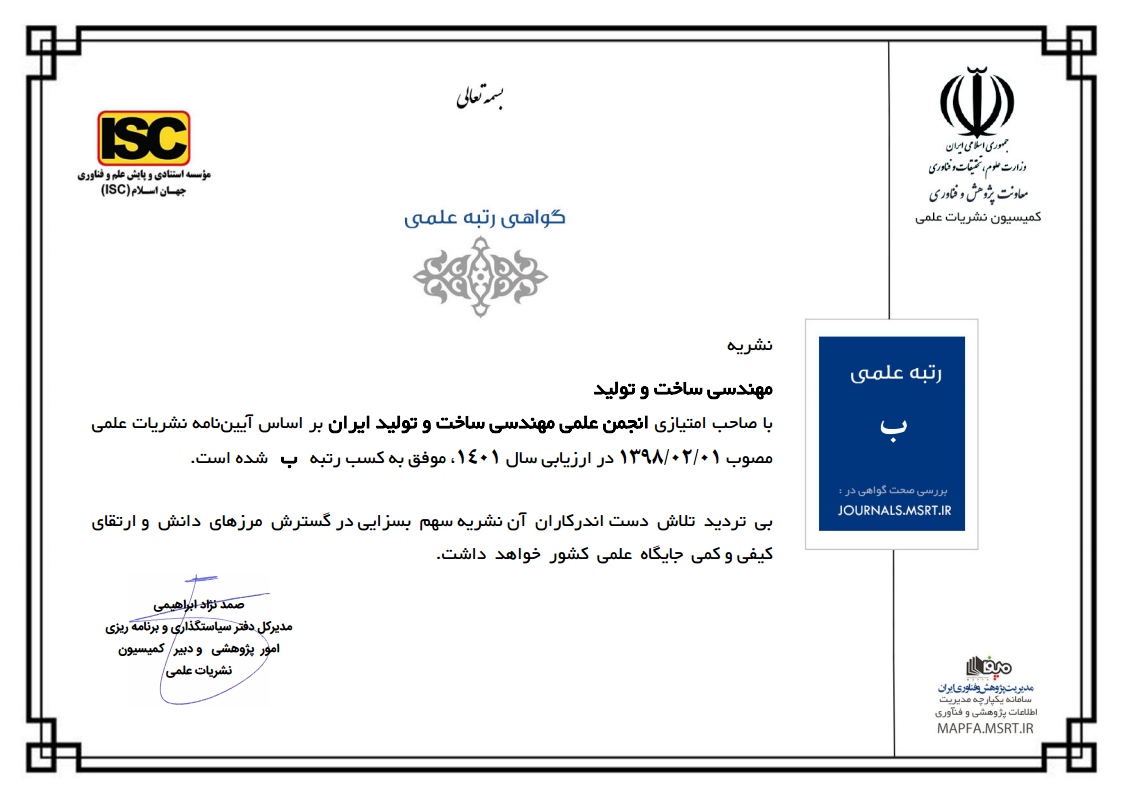
The Journal of Manufacturing Engineering, owned by the Iranian Society of Manufacturing Engineering, has been published since 2012 with the aim of fostering scientific collaboration among universities and national and international specialized scientific associations, and to promote the growth and development of scientific research in the country. Initially issued as a quarterly, it has been published on a monthly basis since September 2019. The Journal accepts and publishes original, previously unpublished scientific-research articles after a rigorous peer-review process and final approval by the Editorial Board, with special emphasis on national-level research and novelty in the field of manufacturing engineering. The average review time is approximately 21 days, and all accepted articles are made publicly available upon final publication. The Journal utilizes the "HamYab" similarity detection system and, accordingly, manuscripts with a similarity index exceeding 20% cannot be considered for publication.


Join the forum's Telegram notification channel (click on the link below)

https://telegram.me/info_smeir


Address:

Tehran, Intersection of Shahid Chamran and Al-Ahmad Highways, Tarbiat Modares University, Faculty of Technology and Engineering, Room 4-18

Telephone and Fax 021-88220216


Current Issue: Volume 12, Issue 10 - Serial Number 96, December 2025, Pages 1-85 

Keywords Cloud

  • Mechanical properties
  • Surface roughness
  • Additive Manufacturing
  • 3D Printing
  • Microstructure
  • Energy absorption
  • optimization
  • Finite element simulation
  • Residual Stress
  • Finite element method
  • Hardness
  • Delamination
  • Nanocomposite
  • Drilling
  • Severe plastic deformation
  • tensile strength
  • Finite Element
  • Composite
  • Simulation
  • Sandwich Panel
  • Aluminum
  • corrosion
  • response surface method
  • Material removal rate
  • Friction Stir Welding
  • image processing
  • machining
  • Temperature
  • fused deposition modeling
  • Taguchi method
  • Sensitivity analysis
  • ultrasonic
  • Tool Wear
  • Wear
  • Turning
  • Rotational Speed
  • FEM
  • Spring Back
  • Ultrasonic Vibration
  • numerical simulation
  • Genetic Algorithm
  • Grinding
  • graphene
  • Incremental Forming
  • Compressive strength
  • Friction Stir Process
  • Bobbin Tool
  • Machining Parameters
  • Surface Quality
  • Wear resistance
  • Numerical analysis
  • finite element analysis
  • Fused deposition modeling (FDM)
  • Grain Size
  • Milling
  • fracture
  • Residual stresses
  • Cutting force
  • Friction stir spot welding
  • Digital shearography
  • Aluminum 7075
  • Thermography
  • Composite Material
  • Brazing
  • Piezoelectric
  • Porous Structure
  • Spring-back
  • Minimum quantity lubrication (MQL)
  • ABAQUS
  • Composites
  • Hot extrusion
  • structural health monitoring
  • Laser Welding
  • Modal Analysis
  • Friction Stir Processing
  • Dimensional Accuracy
  • Topology optimization
  • Artificial intelligence
  • Aluminum foam
  • Response Surface Methodology
  • Strength
  • Strain Rate
  • Low velocity impact
  • Ultrasonic Welding
  • Powder Metallurgy
  • vibration
  • AA6061-T6
  • Finite element method (FEM)
  • Electrical Discharge Machining
  • Surface modification
  • Corrosion Resistance
  • Finite element model
  • Sintering
  • microhardness
  • Fused Filament Fabrication
  • Fiber metal laminate
  • copper
  • Artificial Neural Network
  • CK45 steel
  • Tensile test
  • force
  • Horn
  • Inter-layering method
  • Metal Injection Molding
  • Reshaping
  • Magnetic field
  • elastomer
  • Electroforming
  • morphology
  • Structural properties
  • Deep Learning
  • polymeric foams
  • Aluminum Alloy 6061-T6
  • Thermoplastic composites
  • Dielectric Constant
  • porosity
  • fatigue
  • Flexural Strength
  • Experimental test
  • Implant
  • Heat treatment
  • Stability
  • CFRP
  • non-destructive testing
  • impact test
  • Damage model
  • Vibration stress relief
  • nitrile butadiene rubber
  • Resistance spot welding
  • Electromechanical Impedance
  • Hydrodynamic Deep Drawing
  • Laser bending
  • Creep
  • Supercapacitor
  • Three-point Bending
  • Cold roll-forming
  • Annealing
  • microfluidic
  • Fiber metal laminates
  • Non-destructive test
  • bending strength
  • Planar defects
  • Curved Surfaces
  • Fatigue life
  • Gas turbine
  • Penetration welding
  • Drilling parameters
  • Accumulative Roll Bonding
  • Polyether Ether Ketone
  • retained austenite
  • Al6061
  • Filler Metal
  • Bone
  • polypropylene
  • Cellular Automaton (CA)
  • Lubrication
  • Sheet Metal Forming
  • Intercritical annealing
  • Hardness test
  • Reliability
  • Resistance spot weld
  • Design of experiments
  • Taguchi
  • Hole drilling strain gauge method
  • glass fiber
  • Friction drilling
  • Dimensional Tolerance
  • Tool geometry
  • Metal Matrix Composites
  • Ultrasonic hammer peening
  • Buckling
  • Formability
  • Dynamic recrystallization
  • Thermoplastic Materials
  • Impact resistance
  • FDM
  • Digital Light Processing
  • FSP
  • martensite
  • FEM ANALYSIS
  • Aluminum matrix composite
  • GTAW welding
  • Specific energy absorption
  • micro-alloy
  • CHIP
  • Carbon Nanotube
  • Ultrasonic Cleaning
  • FEM modeling
  • Second phase
  • Polymer
  • Basalt fibers
  • fracture strain
  • Atomic Force Microscope
  • thermal necrosis
  • Polylactic Acid
  • Metamaterials
  • 3D print
  • Pure Copper
  • Continuous Ultrasonic Welding
  • Fault Diagnosis